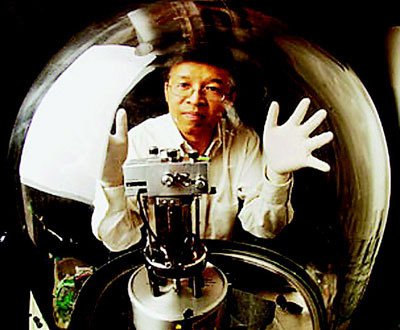
According to a report by the World Journal on August 2nd, the Massachusetts Institute of Technology (MIT) announced on the 30th that Gang Chen, a Chinese-American professor of Power Engineering, and his research team have for the first time broken the formula of the “Blackbody Radiation Law.” They confirmed that heat conduction between objects at extreme proximity can be up to a thousand times higher than predicted by the law’s formula. This research will be published in the August issue of the scientific journal Nano Letters.
The “Blackbody Radiation Law,” established by German physicist Max Planck in 1900, is a recognized fundamental principle of heat transfer between objects. Although some physicists suspected that this law might not hold when two objects are extremely close, they were never able to prove it or provide empirical evidence.
Planck’s “Blackbody Radiation Law” defines heat transfer at different temperatures and holds true in the vast majority of cases. However, stably controlling objects at extremely small distances to conduct energy transfer tests presents an immense challenge. For over a hundred years, scientists were unable to achieve a breakthrough. Even Planck himself held reservations about whether this law would still hold for objects at microscopic distances.
Gang Chen, an alumnus of Huazhong University of Science and Technology and the University of California, Berkeley, is a renowned scholar in nanoscale thermoelectric materials and fluids. His research team used a method of placing small glass beads against a flat object, which is easier to control, instead of two parallel planes, which are nearly impossible to keep from touching at nanometer (one-billionth of a meter) distances. They also employed an atomic force microscope with bi-metallic cantilever technology to precisely measure the temperature changes between the two objects.
MIT stated that the research results of Gang Chen’s team have confirmed a theory that scientists had predicted but could not empirically prove, earning acclaim from international peers in the field.
This discovery not only deepens our understanding of fundamental physics but is also of great importance for industrial applications, such as improving the “recording heads” of hard disks used for computer data storage and developing new designs for energy storage and harvesting.
Gang Chen noted that the recording heads in current computer hard disks are positioned about five to six nanometers from the disk surface. These recording heads tend to heat up, and researchers have been searching for ways to control this heat. Heat conduction and control are vital components of the magnetic storage field, and such applications are expected to develop rapidly following Chen’s discovery.
The new findings could also assist in the development of a new generation of energy conversion devices. Beyond practical applications, Chen said this research provides a useful tool for further understanding fundamental physics. (Reported by Jiali Tang)
When reposting, please include the address of this article: https://kexue.fm/archives/52
For more detailed information on reposting, please refer to: Scientific Space FAQ