In the August following the solar eclipse, wonderful astronomical phenomena will continue to unfold. The Perseid meteor shower will reach its maximum this month, which also marks the beginning of the meteor shower season for the second half of the year. Phenomena such as the oppositions of Jupiter and Neptune, as well as the greatest eastern elongation of Mercury, will once again make planetary observation a highlight.
Observation Focus:
The Sun moves from Cancer to Leo
01: Occultation of Antares by the Moon
06: Maximum of the Southern \iota-Aquariids (ZHR=2)
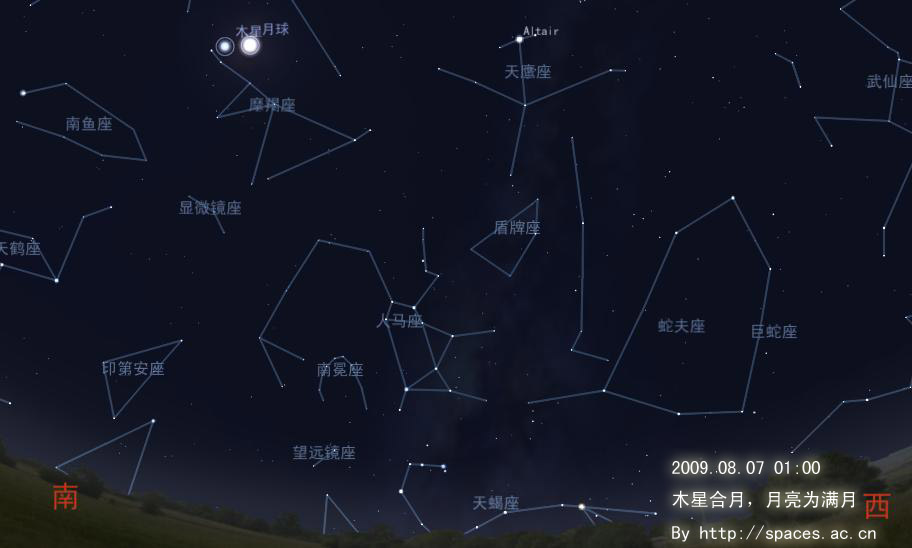
07: Jupiter in conjunction with the Moon
11: Saturn’s rings disappear (inclination is 0 from the Sun’s perspective)
12: Maximum of the Northern \delta-Aquariids (ZHR=5-10)
13: Maximum of the Perseid meteor shower (01:30-04:00, ZHR=100)
15: Jupiter at opposition
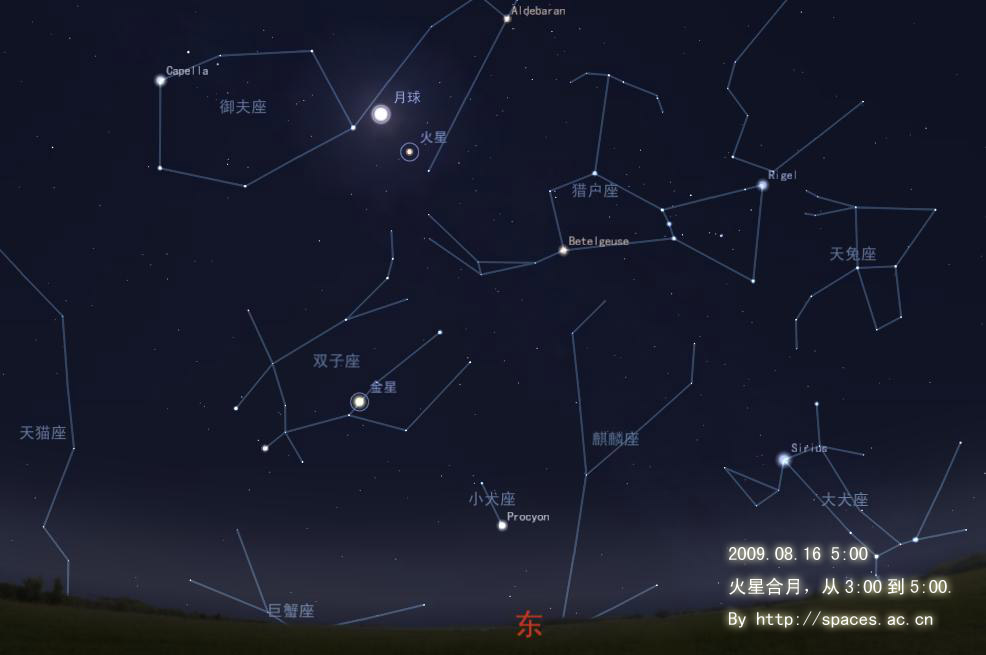
16: Mars in conjunction with the Moon
17: Maximum of the \kappa-Cygnids (ZHR=3)
18: Venus in conjunction with the Moon; Neptune at opposition
20: Maximum of the Northern \iota-Aquariids
25: Mercury at greatest eastern elongation
28: Occultation of Antares by the Moon
Moon Phases:
Full Moon: 06th, 08:55
Last Quarter: 14th, 02:55
New Moon: 20th, 18:01
First Quarter: 27th, 19:42
Observation Tips:
1. Regarding meteor observations, you may refer to: http://cmcn.y234.cn/meteor/visual/catalog/iota_aquarids/iota_aquarids.htm
2. Keep an eye on “Wikipedia” to learn more!
Detailed Information:
The following observation location is: Xinxing County, Yunfu City, Guangdong Province (112.2E, 22.68N)
August 07: Jupiter in Conjunction with the Moon
August 11: Saturn’s Rings Disappear (Inclination is 0 from the Sun’s perspective)
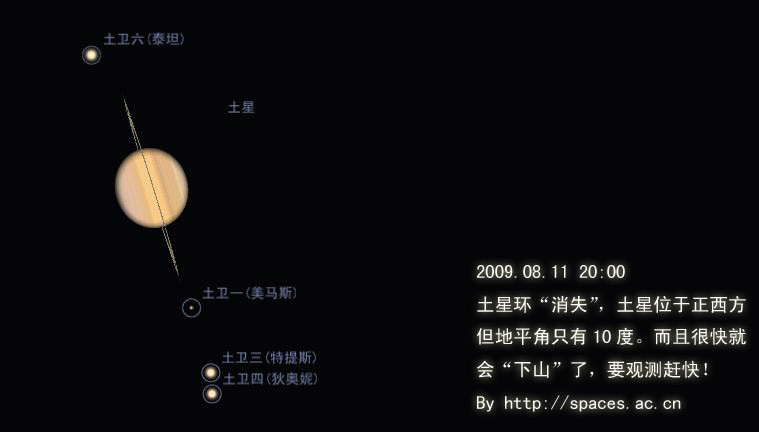
Saturn’s beautiful rings are gone! From August 11 to September 4, the ring surrounding the main body of Saturn will “disappear” from public view for a period of time. This peculiar phenomenon only occurs once every 15 years.
Saturn is the second-largest planet in the solar system and is a relatively unique planet. When viewed through a telescope, a beautiful ring surrounds Saturn’s equatorial plane. This distinctive “straw hat” is composed of substances such as fragments of ice ranging from a few centimeters to several meters in diameter. They rotate around Saturn at high speeds and shine colorfully under the sunlight, leaving observers in awe.
There is an inclination between Saturn’s rings and its orbital plane, with a maximum inclination of 27 degrees and a minimum of 0 degrees. When the maximum inclination occurs, people see the largest area of Saturn’s rings, and Saturn’s luminosity is at its brightest, presenting the overall “straw hat” state. When the minimum inclination occurs, it is difficult to see Saturn’s rings even with the help of large astronomical telescopes.
Contrary to 2003, when Saturn’s rings were maximally open toward Earth, from August 11 to September 4 this year, the line of sight of observers on Earth (the line connecting the observer and the celestial body) will be perpendicular to Saturn’s axis of rotation, making it look as if the planet’s rings have disappeared. Saturn’s orbital period around the Sun is 29.458 years, so every 15 years, Saturn’s rings “disappear” once.
August 13: Perseid Meteor Shower Maximum
The Perseid meteor shower, one of the three major meteor showers in the Northern Hemisphere, is one of the earliest recorded meteor showers in human history. In ancient Chinese books, it was recorded that in 38 AD, the flow of the Perseid meteor shower exceeded a hundred meteors. After the 12th century, observations of the Perseids became more systematic, but its flow continued to decrease. By the beginning of the 20th century, the flow at the peak of the Perseids had dropped to a level of a few per hour. Just as astronomers thought the meteor shower was about to “end its life,” it suddenly erupted in 1920, with the flow reaching more than 200 per hour, giving everyone a huge surprise. In recent years, the Perseid meteor shower has remained relatively stable, with a flow of about 60 to 100 per hour, and it may reach about 10 per hour a few days before and after the peak. The parent comet of the Perseid meteor shower is 109P/Swift-Tuttle. The comet’s orbital period is about 130 years, and its last return was in 1992, at which time the Perseids also experienced a large-scale outburst.
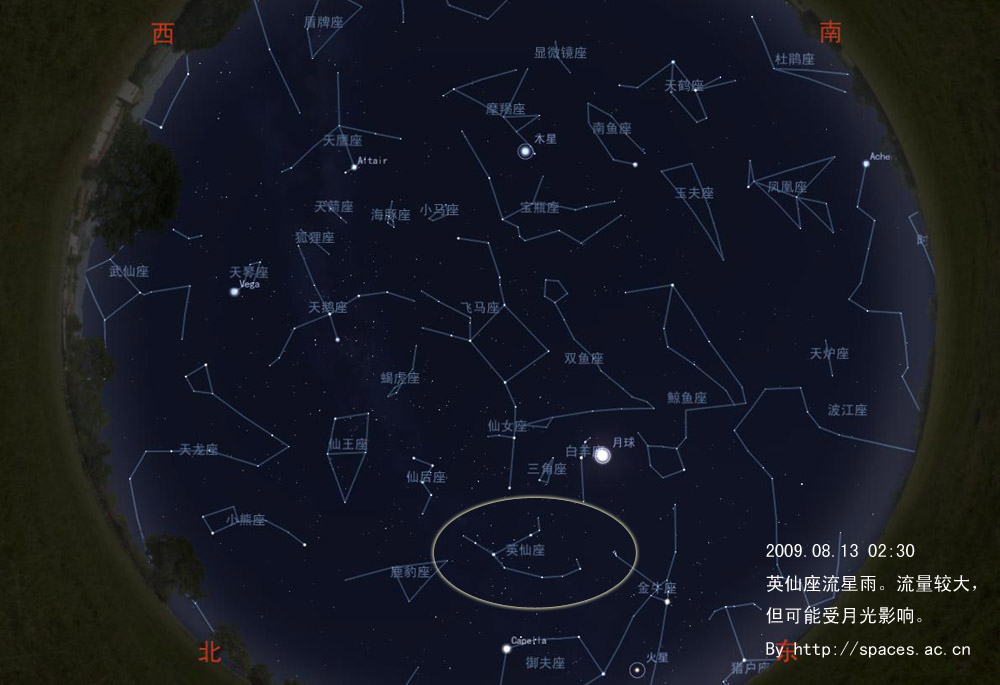
In recent years, Comet Swift-Tuttle has moved away from the inner solar system. No outburst is expected for the Perseid meteor shower. This year, the active period of the meteor shower lasts from mid-July to late August, with the peak occurring in mid-August. According to the forecast of the International Meteor Organization, the peak time is likely to be in the early morning of August 13, Beijing time. The moon phase on that day is the last quarter moon, which will have some impact on observers. However, there is no moonlight interference in the first half of the night. After Perseus rises, it enters the observable period of the meteor shower.
The Perseid meteor shower is an important astronomical event in summer. In most parts of China, the temperature is not too low even at night, making it the easiest meteor shower to observe. During this period, students are on summer vacation, which facilitates the organization of observation activities, but safety issues become even more important. Meteor observation is conducted at night, often involving many participants who generally lack extensive observation experience. Additionally, if a meteor shower outburst occurs, the high flow and bright fireballs will make observers very excited; these factors greatly increase the possibility of accidents. Therefore, when organizing meteor observation activities, special attention should be paid to the following points: First, do not act alone; you can organize a group of people to go out for observation together. Second, try to arrive at the designated observation site during the day and complete the survey of the surrounding environment. Third, divide the observation areas in advance and try not to leave or wander around.
The Perseid meteor shower is an excellent subject for astronomical photography. In the first half of the night in mid-August, the Milky Way spans across the sky. By connecting a camera to an equatorial mount and performing long exposures, it is possible to take a photo of the Perseid meteor shower together with the Milky Way.
August 15: Jupiter at Opposition
This year, Jupiter mainly moves within the constellation of Capricornus. On August 15, Jupiter will rise from the southeastern horizon at sunset, meaning it is at opposition on this day, and we can observe it all night long. At this time, Jupiter’s brightness can reach magnitude -2.9, so it should not be difficult to find.
August 16: Mars in Conjunction with the Moon
August 18: Neptune at Opposition
Neptune is the farthest from the Sun among the eight newly defined classical planets, with an average distance of 4.5 billion kilometers, or about 30 Astronomical Units (AU), and an orbital period of approximately 164.8 years. Due to its great distance from us, Neptune is also the dimmest of the major planets and moves relatively slowly against the background stars. Nowadays, it is not easy for everyone to find it in the vast sea of stars using a telescope; one can imagine the hardships faced by 19th-century astronomers when they discovered it. Initially, John Couch Adams of Britain and Urbain Le Verrier of France calculated the existence of Neptune based on the discovered orbit of Uranus, which made the planet easier to find. The first observation of Neptune was in September 1846. Now, this planet running in a remote and cold region is about to complete its first orbit around the Sun since its discovery. On August 18, three days after Jupiter’s opposition, Neptune will also be at opposition. Recently, the angular distance between these two planets has been very close. Due to Jupiter’s retrograde motion, they had two conjunctions in May and July. However, compared to the bright Jupiter, Neptune is only magnitude 7.8 at opposition, with a brightness about 1/20,000th that of Jupiter.
August 25: Mercury at Greatest Eastern Elongation
Unknowingly, Mercury has moved to the east side of the Sun and will appear low in the western sky in the evenings of late August. On August 25, Mercury will reach its greatest eastern elongation, which is its fifth elongation of the year and the third eastern elongation. During this greatest eastern elongation, its angular distance from the Sun can reach 27^\circ, but its declination is more than 10^\circ lower than the Sun’s. Therefore, in areas around 40^\circ North latitude, Mercury’s altitude is only about 10^\circ at sunset. By the end of civil twilight, its altitude is less than 5^\circ. Even if the weather is good and the observation site is unobstructed, the lower the altitude, the more severe the effect of the atmospheric dust layer will be, making Mercury very difficult to observe at this time.
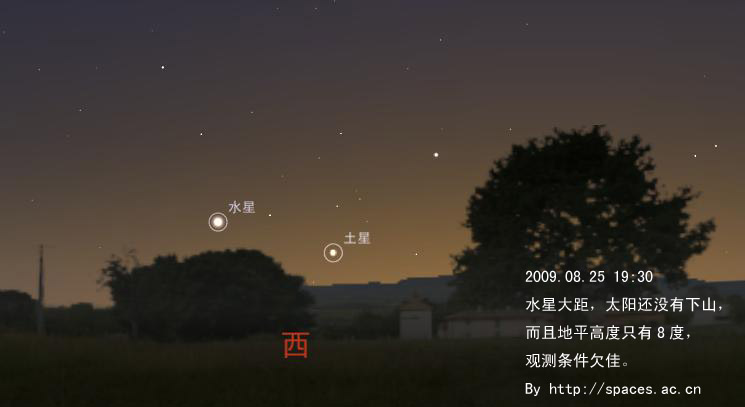
Note: Twilight is caused by atmospheric reflection and refraction. It is the general term for the beginning of dawn and the end of dusk. According to different needs, twilight is divided into three levels: civil twilight, nautical twilight, and astronomical twilight. Their dawn beginnings (occurring in the morning) and dusk ends (occurring in the evening) correspond to the center of the Sun being 6^\circ, 12^\circ, and 18^\circ below the horizon, respectively.
(Part of the content is extracted from “Amateur Astronomer”, images are from Stellarium, compiled by Scientific Space)
When reprinting, please include the original address of this article: https://kexue.fm/archives/39
For more detailed reprinting matters, please refer to: Scientific Space FAQ