For us, Wikipedia is a rare and valuable database, but compared to its English version, the Chinese version pales in comparison. For example, the information on sodium hydroxide discussed in this article can be found in the Chinese version at http://zh.wikipedia.org/w/index.php?title=NaOH&variant=zh-cn, while the English version is at http://en.wikipedia.org/wiki/NaOH.
It is evident how much richer the English version is. To enable everyone to learn more about science, the author has specially translated some materials from the English Wikipedia.
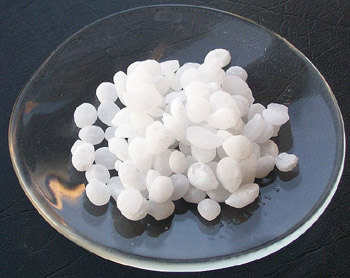
Sodium hydroxide (NaOH), commonly known as caustic soda or lye, is highly corrosive and can dissolve in certain liquids to form strong alkaline solutions, such as in water. Of course, the active component is the hydroxide ion (OH^-). Sodium hydroxide is used in many industries, such as papermaking, textiles, drinking water treatment, soap, and detergents, and is an important chemical raw material. In 1998, global production reached 45 million tons. In the laboratory, sodium hydroxide is a common experimental reagent.
Pure sodium hydroxide is a white solid, commonly found in the form of pellets, flakes, powders, and saturated crystals. Because sodium hydroxide is deliquescent and absorbs CO_2 from the air after deliquescing to form Na_2CO_3, it should be stored in airtight containers. Sodium hydroxide is extremely soluble in water, releasing heat; it is also soluble in ethanol and methanol, though its solubility in these solvents is lower than that of potassium hydroxide (KOH); it is insoluble in ether and other non-polar solvents. Sodium hydroxide solution produces a yellow stain on fabrics and paper.
Physical Properties:
Aqueous solutions of sodium hydroxide can
form sodium hydroxide crystals (monohydrate) between 12.3 and 61.8^\circC, with a melting point of 65.1^\circC and a density of 1.829\,\text{g/cm}^3.
Between -28 and -24^\circC, it exists as a
monohydrate.
Between -24 and -17.7^\circC, it exists as a
heptahydrate.
Between -17.7 and -5.4^\circC, it exists as a
pentahydrate.
Between -5.4 and 12.3^\circC, it exists as a metastable
tetrahydrate (NaOH \cdot
4H_2O).
Chemical Properties:
Sodium hydroxide completely ionizes in water into sodium ions (Na^+) and hydroxide ions (OH^-). Consequently, NaOH can react with any acid to produce water and the corresponding salt. For example, the reaction with HCl: NaOH(aq) + HCl(aq) = NaCl(aq) + H_2O(l) Generally, this neutralization reaction originates from this simple ionic equation: OH^-(aq) + H_3O^+(aq) = 2H_2O Which we usually write as OH^- + H^+ = H_2O.
If it reacts with a strong acid, heat is released. This acid-base reaction can also be used in titration (a common method used to determine the content of amino acids).
There is another type of reaction, namely the reaction of NaOH with acidic oxides, such as the previously mentioned reaction with CO_2, as well as with sulfur dioxide (SO_2). This reaction is commonly used to "scrub" harmful acidic gases (such as sulfur dioxide and H_2S) to prevent their release into the atmosphere. NaOH + CO_2 = Na_2CO_3 + H_2O However, the reality of the reaction is that the acidic oxide dissolves in water to form an acid solution (such as CO_2 + H_2O = H_2CO_3), which then undergoes a neutralization reaction with the base.
NaOH can react slowly with glass to form sodium silicate, which can cause glass bottles containing sodium hydroxide to "bond" with their stoppers. Storing hot NaOH solutions for long periods can damage or even crack glass containers. NaOH does not react with iron because iron is not an amphoteric metal; however, some transition metal elements can react violently with NaOH.
In 1986, an aluminum tank car was mistakenly used to transport a 25% NaOH solution, causing excessive internal pressure and damage. The excessive pressure was due to the following reaction between Al and NaOH: 2Al(s) + 6NaOH(aq) = 3H_2(g)\uparrow + 2Na_3AlO_3(aq)
Unlike NaOH, many metal hydroxides (bases) are not easily soluble in water. Therefore, NaOH can be used to react and form metal hydroxide precipitates. One example is Al(OH)_3\downarrow, which is used as a flocculant to adsorb particulate matter in water, which is then filtered out. Al(OH)_3 is produced in sewage treatment plants by the reaction of NaOH and Al_2(SO_4)_3. This is an important and high-profit synthesis reaction.
Production:
Industrially, NaOH is produced by the electrolysis of saturated brine (the chlor-alkali industry). The reaction is: 2Na^+ + 2H_2O + 2e^- = H_2\uparrow + 2NaOH The reaction with brine is: 2NaCl + 2H_2O = 2NaOH + H_2\uparrow + Cl_2\uparrow Sodium hydroxide is precipitated at the cathode. In production, the destructive effects of chlorine gas must be prevented, because H_2O + Cl_2 = HCl + HClO, and HCl will react with NaOH.
An old method for producing NaOH is the Leblanc process, where Na_2CO_3 is decomposed into Na_2O and CO_2 through high-temperature calcination, and then Na_2O reacts with water to form NaOH. This method is still used occasionally.
In the United States, the main producer of sodium hydroxide is the Dow Chemical Company.
Applications:
NaOH has a wide range of applications, such as:
Alumina production
Soap production
Petroleum drilling
Paper making
Biodiesel production
Illegal drugs
Scrubbing CO_2 from the atmosphere
Aluminum etching
Cleaning agents
Paint stripping
When reprinting, please include the address of this article: https://kexue.fm/archives/6
For more detailed reprinting matters, please refer to: Scientific Space FAQ